Crop Stories - On the Hunt for Heirloom Seeds in the Collard Belt By Dr. Edward H. Davis
On the hunt
for heirloom
seeds in the
Collard Belt
BY DR. EDWARD H. DAVISPHOTOGRAPHY BY MADELINE GRAY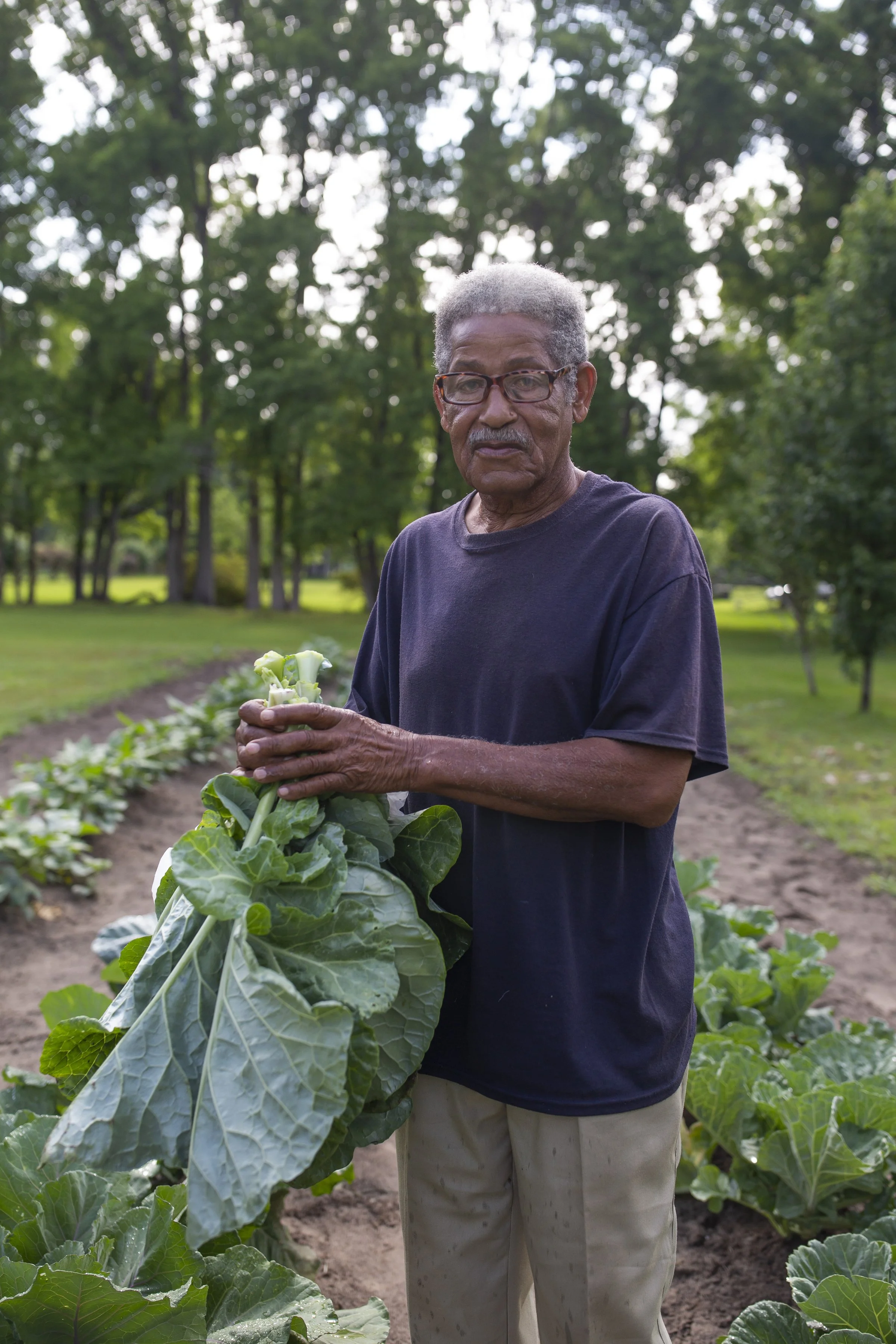
Levi Grissett shows off collards on his family land in Supply, North Carolina on June 4, 2022.
It was a cold January day in 2008, and I had driven the rural North Carolina backroads for days. Then, I found what I was seeking: in the yard of a modest brick home, an unusual shade of bluish green. I pulled over and knocked on the door.
“Excuse me, sir. I noticed your garden as I was driving by. My name is Ed Davis. I’m a geographer, on a search around the Southeast for seed savers. Your collards are different, aren’t they?”
The man smiled and said, “I’ve been expecting you.” Levi Grissett, a 65-year-old Black man, lives on the land where he was raised in Brunswick County just 10 miles from the Atlantic Ocean. It’s a great spot to grow collards: sandy soil, mild winters.
I asked about his reaction.
“Oh, I knew these collards were special, and I figured one day somebody would notice. Come on in, Mr. Geographer, and explain yourself.”
Over coffee, I explained that my partners and I were driving all over the region, hoping to discover the remnant seed savers who had collard seed that dates into the past. Levi told how he was given the seed by an elderly neighbor 40 years ago, and how he saves the seed.
Every other year or so, Levi will save a dozen collard plants in the garden, allowing them to last until the following June. Having flowered in spring (the collard is a biennial plant), they are pollinated by bees and then produce seed pods, called siliq- ues, and each plant can produce thousands of seeds.
Levi’s collard is quite unlike the collard that store-bought seed will produce because it has been maintained in relative isolation from the commercial forms. It looks different — leaves varying in shape, with several shades of green and slight hints of purple and yellow.
My discovery of Levi and his collard patch was part of a four-year exploration project, funded by the U.S. Department of Agriculture (USDA). The USDA had supported this effort because seeds like those I got from Levi Grissett have unique genetics (germplasm), which could help to breed new, disease-resistant varieties of collard, cabbage, broccoli, cauliflower, kohlrabi, brussels sprouts, and kale (most people don’t know this, but those seven plants belong to a single species, Brassica oleracea). For example, heirloom varieties often show resistance to a common disease called black rot, which has been devastating cabbage crops around the world. Breeding researchers tell us that crop biodiversity has been dangerously low, so finding unique varieties will make the world’s food system less vulnerable.
This is an important scientific mission. That’s why plant geneticist Dr. Mark Farnham, director of the USDA’s Vegetable Laboratory in Charleston, South Carolina, was on our team (see his Guide to Collards on page 14). He had been studying collards, cabbage and broccoli for years, and he knew the importance of diverse genes as a source for breeding disease resistance into these crop plants. He convinced us and the rest of the team of the need to save the last of these old varieties as a public asset. Mark told me, “These old gardeners already cherish their stories, their history, and want to preserve that. We just need to show them that they can leave a legacy that extends far beyond their family or their hometown.”
The seed donors (their average age was 70) often traced their seed back to their grandparents. Sadly, most told us no family members were interested in seed saving. For one thing, far fewer people are gardening now than 50 years ago. My partner, John Morgan, and I surveyed 11,000 college and community college students in 10 South-eastern states and found that, on average, 52% of them had grandparents who raised a vegetable garden. But fewer than 10% of them had parents who raised one. In another project, I used Google Earth to map home gardens in a sample of 20 rural and urban South-eastern counties and estimated that only about 5% of homes had a vegetable garden (Note: during the COVID pandemic, home gardening has risen significantly, but not nearly enough to make up for the dramatic losses of the last six decades).
Collard biodiversity was being lost. The seed savers we discovered were elderly and few. The tradition was dying out. This is partly because collard seed saving requires commitment. You must leave your collard plants in the garden all the way into the following summer — cold weather is needed to stimulate the flowers and seed pods.
Indeed, this winter hardiness explains the collard’s dietary significance. Because it is adapted to cold months, a family can harvest a (highly nutritious!) mess of greens every week during the time of year when green vegetables are otherwise unavailable. This is historically important: British immigrants brought collards to America, but enslaved Africans were the ones who introduced a deep appreciation for the nutrition in dark leafy greens.
And so it was with humility and respect that, over several winters, we traveled through Louisiana, Mississippi, Alabama, Georgia, Florida, Tennessee, South and North Carolina, and Virginia. We found collard seed savers in almost every one of those states, but of our 90+ seed savers, the majority were in the coastal plain of the Carolinas. In fact, that region should be considered the core of the “collard belt,” where other kinds of greens (turnip, mustard, kale) are rare, and most people have been growing or at least eating collards for a long time. Our system was straightforward: Drive the backroads, watching for collard patches. Although in some parts of the South the fall/ winter patch will instead have turnip or mustard greens, the single most common greens in a winter garden will be collards.
Upon close looks, a collard patch that had heirloom varieties will have plants that vary within the plot in color and shape. In southern Alabama, we found very purple collards. In eastern North Carolina, we found a range of yellow-green collards. Upon discovery of such a collard patch, we would approach the owner, get their story, and ask for a spoonful of seeds to store in the national seed storage system (seed bank). The grower named the seed, often using their own or a family member’s name. Only once were we turned away, as most people, like Levi Grissett, realize they have something rare and special.
“Every time I meet a collard seed saver and explained myself, I got a big smile in return.”
Discovering those rare heirloom collard patches of gardeners Black and white, I gloried in a landscape colored green by that appreciation. And those tiny collard seeds, offered to posterity by the loving hands of rare gardeners like Levi, connect us to an amazing history — which the Heirloom Collard Project now seeks to preserve.
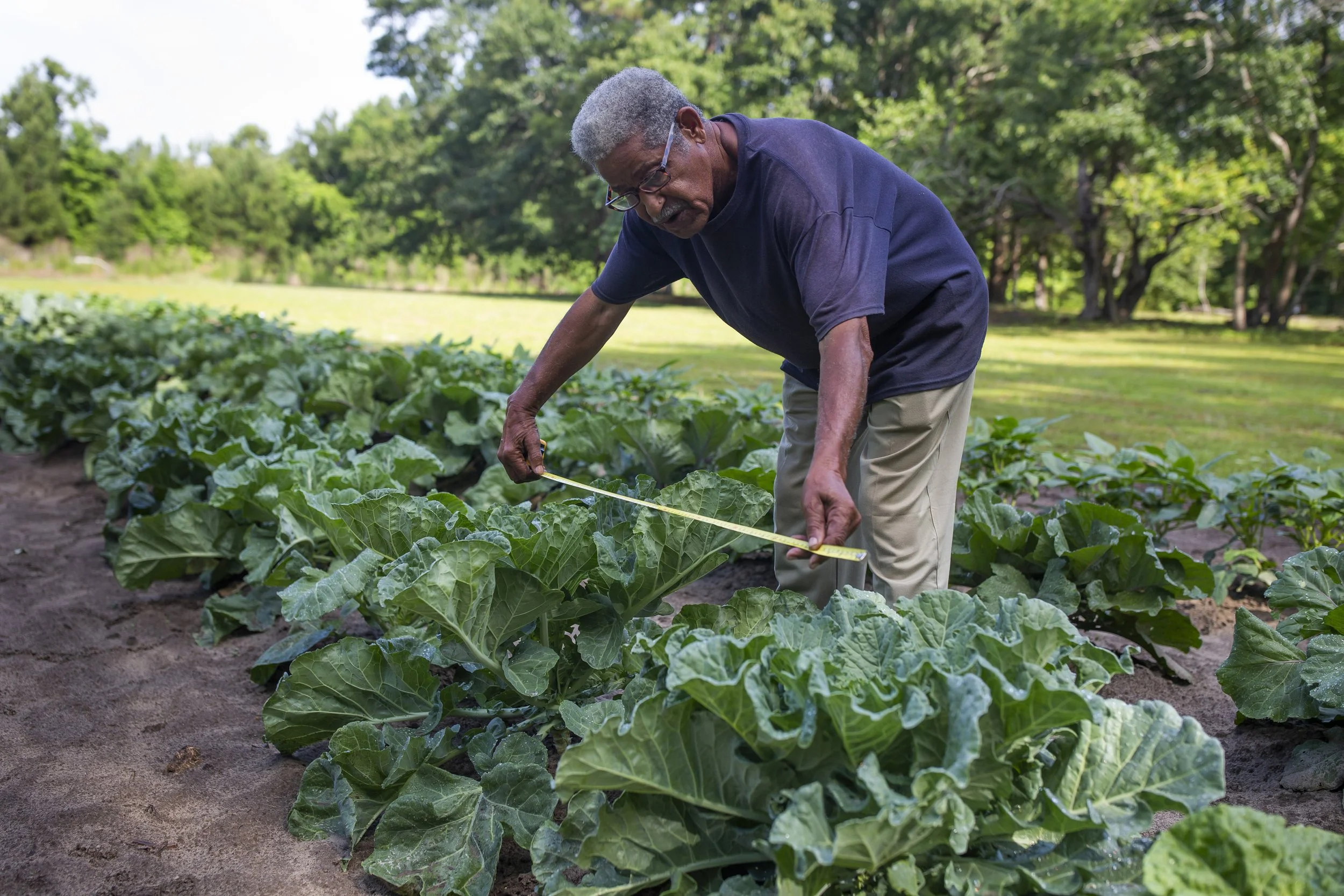
Grissett, known locally for his extraordinarily large collards, measures leaves. He got seeds passed on from a neighbor and added those perhaps century-old seeds to the USDA collard seed bank.
Listen to Episodes of the Crop Stories Podcast. Look out for an episode featuring Ed Davis's piece, out May, 2026.