Crop Stories - Peas - The Vigna Monologues
The Vigna
Monologues:
tiny essays on the
legumes we love
Artwork by Yasmin Ahram

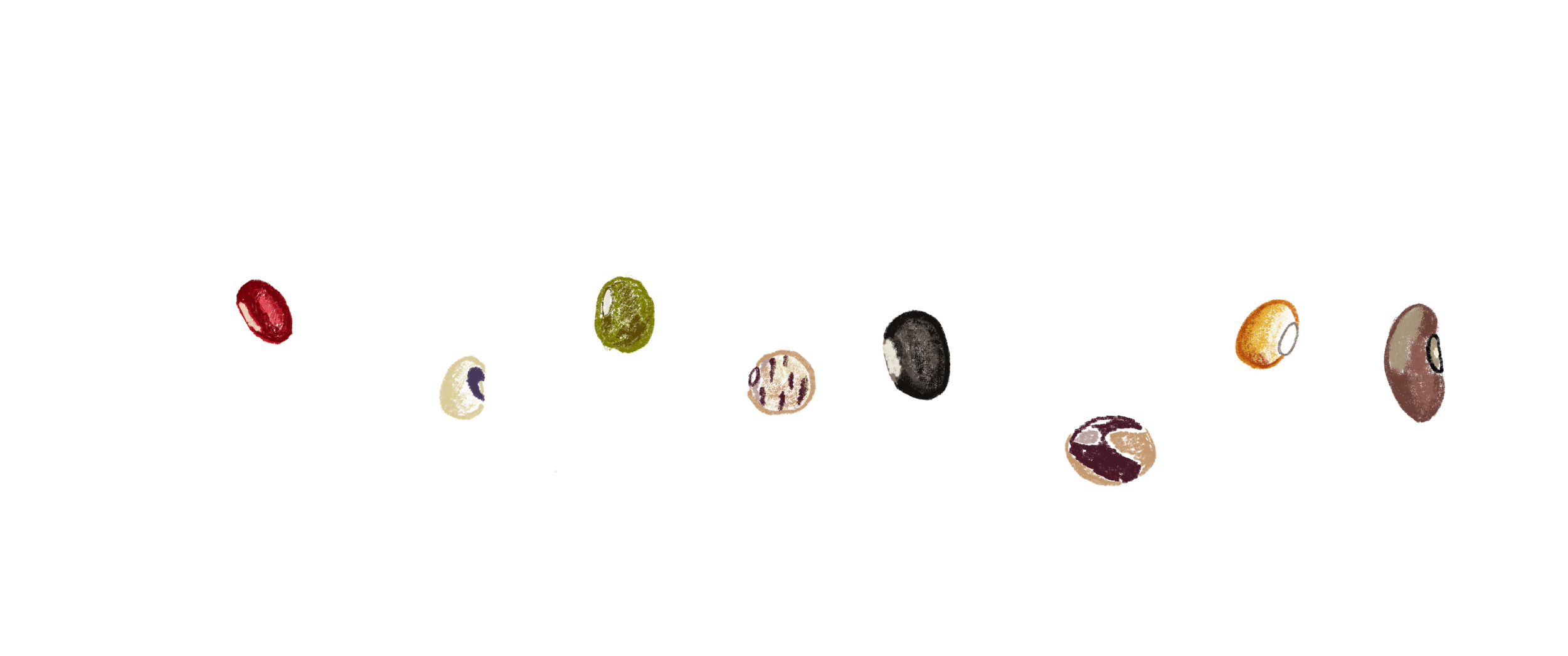
I’m obsessed with Vignas. It’s true. They come in all sizes and colors, each deliciously unique. From the adorable fuzzy pods of Vigna mungo, roughly the size of a chubby matchstick, to the multi-colored marbles of Vigna subterannea, and the *actual* yardlong pods of Vigna unguiculata subsp. sesquipedalis. Vigna unguiculata is the star of this particular edition of Crop Stories, but I’ve yet to meet a Vigna that I didn’t fall in love with. I’m delighted to introduce you to these six legume lovers, who in turn, will introduce you to their beloved
Vignas. —Chris Smith

Adzuki Beans (Vigna angularis)
by tomoko hatakeyama, japan
Adzuki beans are indispensable to the Japanese. For celebrations, they’re cooked together with rice. They are also mixed with anko (red bean paste), which is boiled and then kneaded with sugar to make a healthy sweet. Do not throw away the boiled water. It is a diet tea that removes edema from the body.
This year, I planted adzuki seeds next to the green tea tree. Spiders live there, and the pests get eaten. Beans nourish the earth. Herbs grow wild, and the flowers attract bees to pollinate them. Aromas keep insects away and purify the earth. When I place pulled or overgrown plants on the ground, they keep the soil from drying out and the plants return to the earth. It’s all win-win. No pesticide or fertilizer is needed.
Sometimes the moles push up debris from the ruins of old times. This place had a great view and a castle. Samurai would have eaten adzukis. Amazing. With the debris in my hands, I soak into the history.

Southern Peas (Vigna unguiculata)
by sadia pollard, south carolina, usa
We cook black-eyed peas for New Year’s to bring us prosperity. Peas are coins; collards, or any greens, are dollars. My mother doesn’t know why we do it, but she knows it’s important.
I worked as a student research assistant in college. A hum grew as the sun rose in the crowder pea plots. The bees worked alongside us, pollinating while we analyzed insect traps. The names Whippoorwill and Texas Cream introduced me to a world beyond the white pea with a black eye.
This past year, on my young farm, I grew a pea called Fast Lady Northern. A small cream-colored pea with a milky eye. It grows fast, sending out tons of yellow flowers to produce one big flush of pods. I laid the dried pods on a tarp and stomped and danced to release the seeds. Music was necessary. I recommend “F.A.M.” by Opus and the Frequencies.
The Fast Lady cooks into a big pot of creamy white bean, roasted garlic and rosemary soup, which I shared at our second annual garlic planting party. I saved enough seed for replanting next year and hope, in time, pea soup and garlic planting becomes another annual ritual.

Yardlong Beans (Vigna unguiculata)
by julia chang, california, usa
I was Jack in my own right, reaching skyward to pick the leathery purple pods dangling 15 feet high. This long bean had escaped the confines of its trellis and wound its way up the metal beams of the high tunnel, forming a canopy above the tomatillos and cucumbers. As I maneuvered the unwieldy ladder down the bed, the rush of morning harvest slowed to a crawl.
Some crops make a habit of eluding the conditions we set for efficiency of cultivation. Corn pollinates “promiscuously”; long beans grow inches in a day, as if intent on bridging the distance between sky and earth. In pauses between shifting the ladder, I could almost see their tendrils spiraling in the air, a chorus of snakeheads hunting sightlessly for something to tether their climb. Harvest is an arrival at compromise. This ceiling of beans, the plant slipping past the constraints of production farming to pursue its own desires.

Udad (Vigna mungo)
by rushina munshaw ghildiyal, india
Having grown up in a Gujarati home in Western India, I had only eaten udad dal in a dish by the same name until I married into a family from Garhwal in the northern Himalayas. I discovered just how ancient, valued and revered udad dal is in the Indian culinary lexicon. Mah or mash dal as Vigna mungo is known in India, is widely consumed and cooked in a staggering array of dishes. My mother-in-law taught me that udad, in all its forms, is one of the hardest legumes to digest and must be cooked with asafoetida [gum resin in powder form, which amps up flavor] and other ingredients to balance out its effects.
Whole udad beans are slow-cooked into warming dals across the cold northern regions. The most popular of these is the creamy mah di dal of Punjab, which evolved into the legendary dal makhani of global restaurant fame. Split udad with the skin on is soaked and ground to make pakoras (fritters) in many parts of north and central India. In Uttarakhand, these udad pakoras are considered extremely auspicious in our homes. Split skinless udad is mostly used in the warmer western, southern, and eastern regions of India in lighter dals, vadas and pakoras. Udad is also used prolifically across south India in fermented batters used to make idlis and dosas as well as tempering for south Indian chutneys and sambars.

Mung Beans (Vigna radiata)
by linh aven, california, usa
Growing up in southern California, my first connection to my Vietnamese heritage was through food. In particular, bánh cam, a golden, fried, sticky rice ball rolled in sesame seeds and stuffed with a sweet and creamy mung bean paste. It may seem odd to see beans in a dessert, but I think it symbolizes the resourcefulness of the Vietnamese people to elevate such an ingredient. In fact, mung beans also show up for Asian New Year in a special dish called bánh chưng, a square, sticky rice cake wrapped in banana leaves and filled with pork belly and mung beans. Last February, I flew home to celebrate Tết with my family. Afterwards, on our way to the airport, my mom made us turn the car around because I forgot to pack my bánh chưng. Lugging my bag, now 5 pounds heavier, through security, I was once again reminded that food is love.

Bambara Beans (Vigna subterranea)
by andry andriamananjara, madagascar
Since I was a child, bambara groundnuts have been one of my favorite dishes. We call them voanjobory, which translates to round bean or nut. Like other grains in Madagascar, bambara beans are cooked by themselves or with some meat. They are cooked more soupy-like with zebu (rò voanjobory) or cooked slowly with pork as a sort of stew (henakisoa sy voanjobory).
Traditional Malagasy cooking is not very sophisticated because people cook to fill up their stomach and not so much for the taste. We use basic ingredients such as water, salt, onions and tomatoes (if they are affordable). Sometimes adding chili on the plate while eating, but not in the cooking pot like [elsewhere] in Africa.
Bambara groundnuts typically grow in arid/semi-arid conditions, so they’re not seen on the east coast of the island, which is too humid. In the "eld small yellow flowers appear at ground level. We cover these flowers with soil to have beans at harvest, which grow underground like your peanuts do.