Crop Stories - A Farmer’s Learning Curve By Kamal Bell
A farmer’s learning curve
BY KAMAL BELL
As each year ends at Sankofa Farms in central North Carolina, customers inquire about one crop more consistently than all others: the collard green.
“Will you have any collards ready for Thanksgiving?” they ask. I respond with a smile and the same answer: ”They are almost ready.” I try to accommodate them and point them to our lettuce, chard, kale or Hakurei turnips. But from my experience as a grower, there is nothing more disappointing than telling someone that you don’t have collard greens — other than losing an entire crop of them.
The first time we grew collards, we completely fumbled. At Sankofa Farms, which is now 6 years old, we use compost, which mixes very well with the red clay in Orange County, North Carolina. At the beginning of our journey, crops with thick stems, like collards, would rot because of excess moisture. Red clay is high in iron, but holds water longer than other soil types and needs some sort of amendment to better drain the soil.
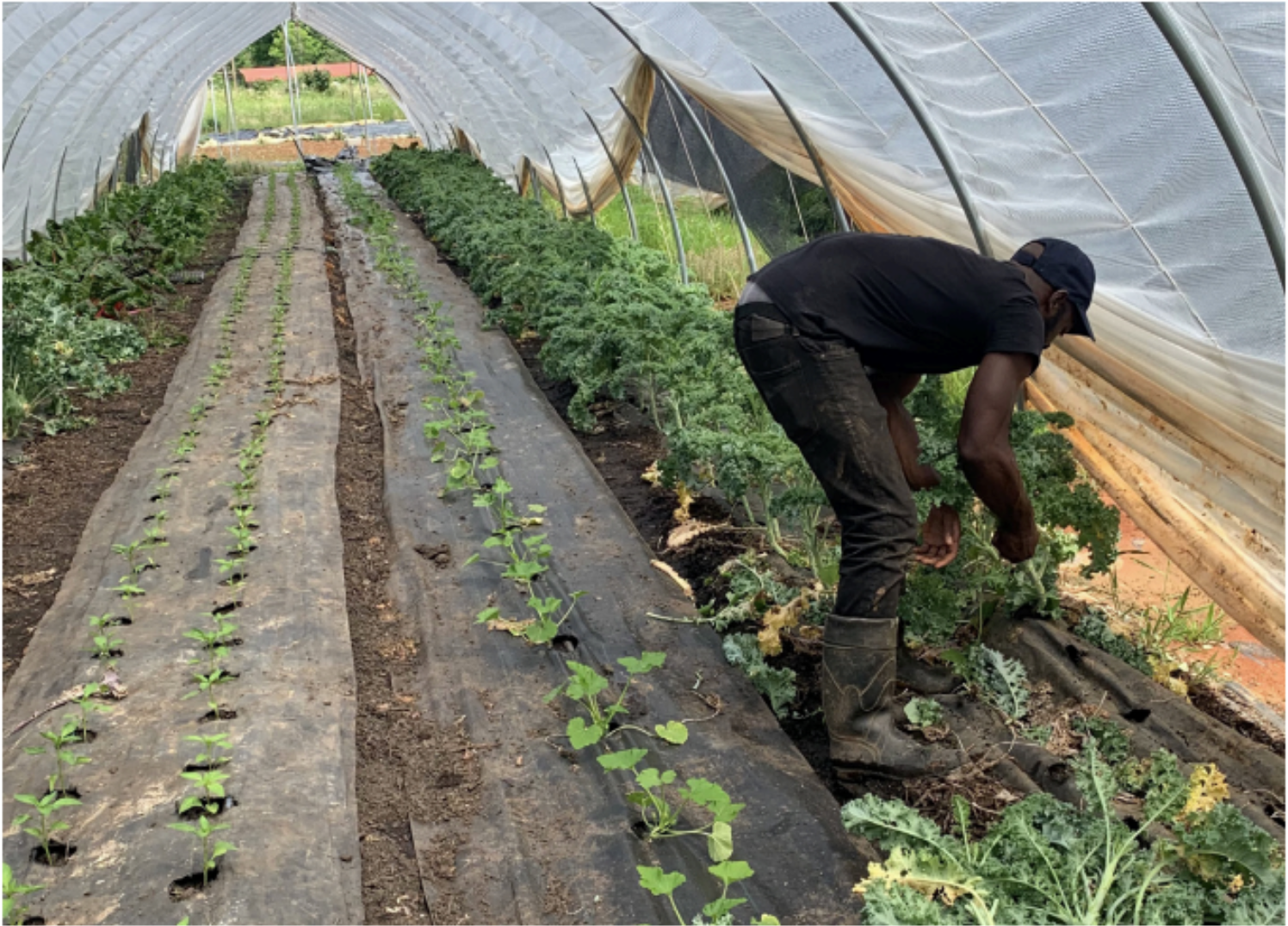
Our growing beds are 30 inches by 100 feet, with two transplants every foot. This equates to about 200 plants on a grow bed. Imagine, after prepping with compost and taking the time to plant hundreds of plants, watching them slowly rot due to excess watering. It was truly a sad sight, but it was also a great learning experience. We now set our irrigation timers for 20 minutes every two days during the colder months and begin planting our Georgia Southern collards in mid-October.
This collard from transplant — unlike your chards, kales and mustard greens — takes around 45 days to mature. We choose to plant our collards in the early fall because we do not have an established seedling house. We use floating row covers inside our plastic tunnels for extra frost protection during late freezes we sometimes have in planting zone 7b.
You have to learn your land and your plants, and that learning comes from problem-solving and sometimes the experiences of those closest to you. When it comes to frosts and plants, I learned a trick from my mother, Paula Bell, who grew up with a small garden in Oriental, North Carolina. I don’t know if it’s an instinct, but as we near October, my mother begins her subtly aggressive ask, “When are you harvesting your collards?”
Then she follows with “Make sure you let them get one frost. The frosts make them tender!’ I respond with a smile and say “I know, Ma.” There is pure joy in this moment of exchange, shared joy we can attribute to the collard green. My mother isn’t a scientist by trade, but her suggestion works really well. When collards experience their first frost, the plant converts starches to sugars, which give the leafy greens a sweeter taste and tender texture.
Aside from tenderness and taste, a major plus of the collard for my farm has been the lack of pests throughout its growing cycle. In any growing season, pests can be a significant barrier in crop production. I have probably lost 400 heads alone of lettuce this year to aphids, but the collards somehow remain resistant. It may be that the collards’ slower growth rate makes them less desirable to a pest seeking a quick, destructive snack. Aphids love nitrogen, and since lettuce grows quicker, they want nitrogen-laden new leaves.
It’s almost like nothing bothers my collards. Over the past few seasons, I have noticed a considerable change in our region’s weather patterns. At first, our winters seemed mild, with a 55-degree day every week and a half. But now the Triangle region seems to receive more rain and varying stretches of warm weather during historically colder periods. In January, two consecutive weeks of mid-60 days were followed by a cold snap, with temperatures in the teens. The chard and Redbor kale didn’t like those wild swings too much, but the collards were unfazed. When it’s time to cover our crops, I know that I can count on this one crop to survive.
As I reminisce on my
experiences with this plant,
I understand how the
Georgia Southern collard
became a staple in our food
culture. If you want a hardy, t
asty and productive winter time
vegetable, then collard greens
are an excellent choice,
especially for new growers
searching for market-ready
crops.
And for me, the collard reflects
the characteristics of Black
people in America. My people
are survivors, dependable,
majestic, and sometimes
impervious to forces outside of
our community. Perhaps this is
what my ancestors saw in this
plant. There is beauty and
significance in the thick, firm
stalk that pushes it through the
cold months, and in the leaves
that push upward and outward
as they reach to the sun.
Listen to Episodes of the Crop Stories Podcast. Look out for an episode featuring Kamal Bell's piece, out September, 2026.