Crop Stories - Purple Tree Collards By Max Walker
Why the purple tree collard is the official plant of Richmond,California
By Max WalkerIt’s fall in Richmond, California, and you cannot go a block in the Belding Woods neighborhood without encountering a row of peppers, the last of summer’s eggplants and, most importantly of all, purple tree collards. You can spot the purple shoots here and there, lining picket fences and along hedges and home gardens, obvious for their distinctive bacchic hue. Some of the low buildings along the Richmond greenway even show the plant in colourful murals.
Purple tree collards are special in this city on the fringes of San Francisco. The hardy perennial brassica is known locally as “Richmond’s Pride.” Since 2010, it has been the city’s official plant and, more recently, inspired a picture book about food and community. This plant is a symbol that tells a story beyond Richmond’s borders, of Black migration, slavery and farming in the United States.
Few people know the story of “Richmond’s Pride” as well asAnne Evanston and Earl Butler. The couple, both in their 40s, settled in the San Pablo neighborhood 14 years ago. Evanston works as a professional speaker and Butler as a benefits consultant. Their house is proud with red paint and carefully planted boxes of vegetables. Butler built the boxes and filled them with compost made in old wine barrels. Evanston laughed that they had ended up with a mole, “so poor Earl had to take all the earth out and line them with Mole Guard.”
Butler’s grandfather, Willie, arrived in the 1940s to work on the “Liberty ships,” cargo vessels built in Richmond’s shipyards during World War II. “My grandfather had said, ‘I don’t want to be a farmer,” said Butler. “America was a split country. The Great Migration was caused by Jim Crow in the South, so the only option they had was to leave Arkansas.’’
While many Great Migration narratives focus on Northeastern cities, Butler’s family of 14 arrived on the West Coast, where Richmond High was overwhelmed by the population growth. Children were educated in three shifts per day. Suddenly, 1,500 children required school meals. Dr. Kelley Fanto Deetz, a writer and director of collections and visitor engagement at Stratford Hall Plantation in Virginia, says Richmond became a “Harlem West,” as the workyards drew in high numbers of African Americans to work in the war industry.
These communities returned to the hardy purple tree collards, which could grow up to 6 feet tall from cuttings carried in the bags of those Southern migrants. Butler refers to the descendants of enslaved peoples as “the best damn farmers in the world,” for their knowledge that three or four plants could provide a dish of collards much of the year. Collards were integral to the enslaved and slave owners alike, then to African Americans in freedom. Deetz emphasized that “community gardening and gatherings were an essential part of these newly forming Black communities, and of course collards were a nostalgic green that would have helped many folks feel a sense of home in their new West Coast city.”
The plants do not typically flower; instead cuttings are taken from a “mother plant.” These cuttings would have once meant hope in a distant field, far from home. Doria Robinson, director of Richmond’s community farm Urban Tilth, says of purple tree collards “sharing pieces of its body propagates it; passing it from person to person is so utterly Richmond.” The plant’s resilience and lineage reflect that of Richmond’s ethos. For Evanston, “part of the pride of Richmond is that we were able to take care of the kids ourselves.”
Evanston and Butler curate this rich cultural inheritance on their own small patch of America. They grow milkweed for Monarch butterflies. Evanston makes flavored vodka with passionfruit, whose vines entangle their small garden fence. She dries, ferments, and“cans, all of that stuff,” reinvigorated by Covid to provide for her household and neighbors.
“Community gardening and gatherings were an essential part of these newly forming Black communities, and of course collards were a nostalgic green that would have helped many folks feel a sense of home in their new West Coast city.”
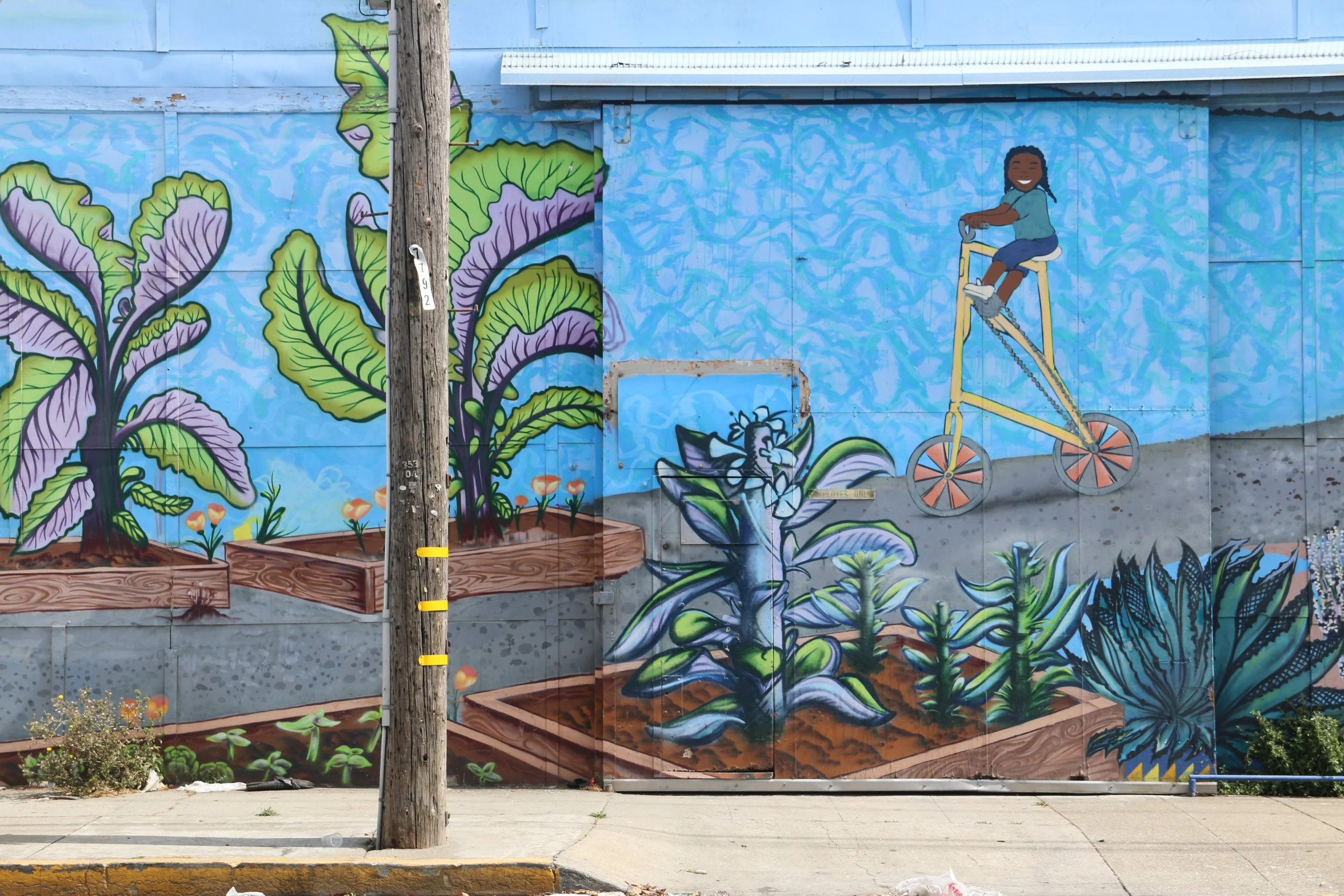
A community mural including purple collards in Richmond, CA.
In September 2021, Richmond locals (including volunteers from Urban Tilth), gathered to cheerful music in Greenway Park. They turned out to celebrate the self-published book Follow the Plant, Follow the Story: Purple Tree Collard with a community litter pickup, giveaways of young purple tree collard shoots and magnolia blooms, and a sneak peak of the book. One young Richmonder, Tania Pulido, started writing after an explosion at the local Chevron refinery in 2012. Describing the impact, she said, “We didn’t even know if it was safe to grow food anymore.” Pulido remembers the days after the explosion when, along with other members of the community, she pulled collards and other spoiled crops from the soil and dumped them on the steps of the City Hall to protest the lack of information on the disaster. “Nothing can grow if the soil is poison,” she said darkly. Pulido hopes that her book, illustrated by Vanessa Solari Espinoza, will be used by educators because “growing up in Richmond, I wasn’t taught [the purple collard’s] history, so the idea is that the book can be used as a tool to talk about forced migration, urban farming, and social justice.”
Earl Butler is hopeful. “Man, if you’d told me when I was 30, that I would be doing this gardening, then I don’t know what I would have said. But these skills are no different than knowing how to cook. Heck if you’ve got one [growing box], you can do a lot!"
There is a strange quality to the trajectory of this plant. A plant that is traced to Europe grew to prominence in the U.S. South. It then crossed North America with the Black farmers who cultivated it, arriving in Richmond, where it would feed schoolchildren and workers building ships to supply wartime Europe. It’s a return, a circle of historical irony, telling of nourishment and starvation over centuries.
Listen to Episodes of the Crop Stories Podcast. Look out for an episode featuring Max Walker's piece, out June, 2026.